

AI offers people new ways to explore who they could become—and new descriptions of who they already are.

People often discover what they want while explaining it to someone else. A vague ambition becomes a plan. A difficult week becomes a reason to change something. A passing interest turns out to matter more than expected.
Conversational AI can take part in that process. Unlike a list of search results, it can ask another question, draw on a previous exchange and offer an account of the person behind the request. Its response may feel like recognition, even when it rests on an incomplete interpretation.
Over the next one to three years, we expect some consumers to use these exchanges to explore possible lives, rehearse unfamiliar roles and reconsider what they want. At the same time, they will encounter versions of themselves inferred by systems and used to shape subsequent experiences. Sometimes those descriptions will feel helpful. Sometimes they will be difficult to escape.
A customer may arrive at a service unsure what they want and leave with a new account of the life they would like to lead. That gives the business a role in how preferences form, as well as how they are served.
What drives this
Identity has always developed through encounters with other people, institutions and culture. Commerce participates, too: the things people buy can express who they are or help them attempt a different way of living. AI gives that exchange a conversational form that can continue over time.
The system's account does not begin and end with what a person declares. In his 2011 work on algorithmic identity, John Cheney-Lippold describes categories inferred from behaviour and then used to shape people's digital encounters. Our extension is that an assistant can deliver such a description in language that feels personally perceptive. A tentative interpretation may acquire more authority when it sounds like someone understands. [62]
There is a business incentive to be present while preferences are forming. Helping someone explore a new interest can create demand, rather than simply serve an existing request. That can be useful to the person. It also makes the purpose of the conversation important: is the service helping them examine alternatives, or making a commercially useful interpretation easier to accept?
A chance to try another version
Research offers a glimpse of the constructive possibilities. In a 2024 study of Future You, people conversed with an AI-generated older version of themselves. The brief intervention improved reported connection to a future self, but did not establish durable changes in behaviour. It was a simulation built from personal input, not a prediction. [63]
The attraction of that approach is the room it offers for exploration. A person could examine what a different working life or daily routine might involve before committing to it. A useful service might help them see alternatives they had not considered, without treating the first plausible story as their destiny.
Other evidence gives reason to be careful about agreeable advice. Myra Cheng and colleagues' 2026 research found that affirming AI responses could leave people more convinced they were right in a conflict and less willing to repair it. Participants still preferred the agreeable systems. Those interactions do not establish permanent personality change, but they show why a satisfying exchange is not enough to judge the advice. [64]
Customers who are still changing
For businesses, the opportunity is to serve people whose preferences are taking shape. A learning service could help someone explore an unfamiliar interest without immediately assigning them a new identity. A travel or lifestyle service could offer different ways of living an aspiration, including alternatives that involve buying less.
Take particular care when a description affects how a person is treated. Ruha Benjamin's work challenges the supposed neutrality of technical classifications: they can carry existing inequalities into new settings. A confident account of a customer can still misread them, and the consequences will not be equal for everyone. [65]
People will also differ in how much continuity they want. Some may welcome a service that remembers their history; others may want to explore a possibility without adding it to an enduring profile. Helen Nissenbaum's account of contextual integrity gives a useful foundation: information shared for one purpose does not automatically belong in every other setting. [67]
The valuable relationship will leave room for a customer to change their mind, reject a description or start again. What could your service help someone discover without deciding, too early, who they are?
Early signs of change.
by TrendWatching
3 selected innovations from the Innovation Database. Each helps explain an aspect of the shift. None establishes that the whole forecast will happen.

Likeness services add identity verification and takedown requests
Twinnin offers services for verifying identity and managing AI uses of human likeness.
Identity and objection records give people a way to contest AI uses of their likeness; successful prevention is not guaranteed.
Why this example is here
Identity verification, objection record and takedown requests; not guaranteed prevention/removal/enforcement. Partner network potential reach is not actual active users.
Original sourceEditorial selection · reviewed 1 Nov 2026
A digital wardrobe starts trying on beauty, too
Beauty brand e.l.f. Cosmetics and AI styling app Alta
A commercially shaped digital self becomes a place to explore appearance.
Why this example is here
This is a commercial styling integration, not evidence that using an avatar changes someone’s identity. The issuer says Alta will recommend e.l.f. products; it is not a neutral comparison across all beauty brands.
Original sourceEditorial selection · reviewed 1 Nov 2026
Experience image
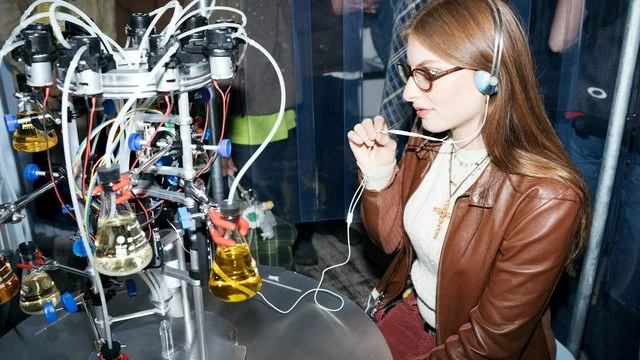
A spoken memory becomes a personal fragrance
London fragrance house Index
AI helps turn autobiographical narrative into a personal expression.
Why this example is here
This interprets a story rather than reproducing a memory or demonstrating lasting identity change. The September pop-up has ended; a separate October event was also temporary.
Original sourceEditorial selection · reviewed 1 Nov 2026
Dates distinguish launches, announcements and substantial updates. Examples with a more indirect connection are labelled.
Explore the sub-shifts
These more specific changes show how the main shift could play out in everyday life.

“THE ASSIGNED SELF”
A system’s description of a person can start changing the choices they see.

“POSSIBLE ME”
A possible life becomes something people can rehearse before committing to it.

“WHOSE IDEA WAS THAT?”
Consumer preferences can form inside a helpful conversation.

“NOT ALL OF ME”
People may want continuity in one part of life without carrying it into every other.
THE SOURCE NOTESFollow the thinking 5 sources · what they show and where their limits lie
Sources and further reading
These sources inform the article. A product announcement describes an offer, not how widely people use it. Arguments and imagined futures are kept separate from observed results.
Behavioral categorization and its consequences. Written before conversational AI; applying it to assistants is our interpretation.
Brief intervention, 344 participants. Some short-term self-report benefits, several null outcomes; not a forecast, therapy validation or demonstrated durable behavior change.
Conflict-related judgments and repair intentions changed after interaction. Does not establish permanent personality change or effects from every assistant.
Explains discriminatory design and apparent neutrality. Used as a conceptual challenge, not a current population estimate.
The argument concerns appropriate information flows, rather than secrecy alone. The identity boundaries proposed in our article are an application of that thinking, not a guarantee of technical capability.
About this research edition
This article draws on selected sources and our interpretation of their implications for consumers. The wider collection contains 50 articles and original illustrations. We have not read everything by everyone on the reading list, calculated the probability of each future or established worldwide adoption. The collection is not exhaustive.
The illustrations are AI-generated, with a visual approach informed by TrendWatching’s 2024 and 2025 reports. They depict ideas rather than observed events. If an article’s central idea changes, its image needs another look. Small edits need not mean a new illustration; automatic replacement is not active.
Each innovation has a source, a review date and an explanation of its relevance and limits. Some are early signs of the change; others offer a useful comparison. None proves the forecast. Monthly monitoring and automatic selection of new examples are not running.