

People want help living with their health. Prepare for a much more demanding relationship.

Being unwell comes with a surprising amount of work. Finding the right person to ask. Remembering what happened last time. Explaining it again. Then fitting the advice around a job, a family and whatever else the day requires. Even people who feel well can find themselves managing a growing collection of readings, reminders and things they ought to improve.
AI promises to take on some of that work. It can help explain unfamiliar information and prepare questions, while connected devices make more of everyday life available for interpretation. Together, they raise an expectation that reaches beyond a better consultation: support that follows a person through the gaps, without requiring them to become the manager of an increasingly elaborate health project.
Over the next one to three years, we expect consumers to negotiate that relationship more actively. Some will want earlier warnings and closer accompaniment. Others will pay attention to how much reassurance a service supplies, how much worry it creates and whether anyone is available when help becomes necessary. The same person may want different arrangements at different stages of life.
“LIFE UNDER CARE” describes this expanding negotiation over what it means to be looked after. The commercial opportunity includes the practical work around health: homes, transport, travel, insurance, employment and services that remain usable when someone’s circumstances change.
What drives this
People living with chronic conditions have long monitored and managed health between appointments. Wearables and connected personal records extend the information available for that work, while conversational AI adds a way to ask about it in ordinary language. The next step we foresee is a consumer who expects the service to understand something of the life around a result—and to help with what happens next.
Will it understand what makes my case different? In 2019 experiments, Chiara Longoni and colleagues found that concern about AI overlooking personal uniqueness helped explain resistance to medical AI. In a hypothetical skin-check scenario, participants resisted AI replacing a physician, but not AI supporting the physician’s decision. This was a study of acceptance, not better care. [112] For a consumer, knowing who will consider an unusual circumstance could also matter when deciding whether to use the service.
That expectation meets a physical system. A model cannot create an available appointment or someone to help at home simply by identifying a need. Physician Eric Topol’s May 2026 essay on medical AI describes a striking mismatch: some well-studied imaging applications struggle to reach routine care, while conversational systems spread without equivalent evidence for consequential clinical decisions. Coordination, payment and evaluation remain part of the work. [70]
There is also a quieter human need: to spend time being something other than a patient. The World Health Organization’s healthy-ageing framework, published in 2020, centers what people can do and value within their surroundings. That opens a more useful field of ambition than an ever-improving score: staying involved, getting out, making plans and retaining choices while living with an imperfect body. [72]
From information to dependable help
Even the companies making wearables are confronting the distance between collecting data and improving lives. In an October 2026 essay, Oura’s chief medical officer Ricky Bloomfield calls for longer, more diverse studies and testing devices alongside counseling and clinical follow-up. It is a research agenda from a manufacturer, not evidence that its ring delivers those outcomes. The direction matters: the service around the reading has become part of the proposition. [111]
For you, that could mean helping a customer complete a referral rather than sending another reminder. It could mean making a recovery plan easier to fit around paid work, or ensuring a family knows who has agreed to handle the next step. These opportunities need qualified partners and clear responsibilities. A reassuring answer cannot substitute for available follow-up when someone needs professional help.
Health is an unusually consequential place to discover that difference. An Oxford-led study reported in February 2026 found that people working through medical scenarios with language models did not reliably obtain the benefits implied by the models’ standalone performance. It studied simulated decisions, not recovery. Still, it shows why a capable answer and useful assistance must be evaluated separately. [71]
A relationship people can live with
The four shifts that follow explore different demands within this relationship. Continuing support between encounters. Help acting on an uncertain future risk. A market in the promise of ageing well. And the wish to receive care without organizing an identity around constant improvement.
Those demands need not produce one ideal customer journey. Someone may welcome detailed tracking during recovery and want far less of it afterwards. Another may enjoy measurement for years. Make it possible to change the arrangement without losing access to appropriate care.
If you are building in this territory, look at the work that remains with the person after your service has done its part. There may be a valuable next offer in the unanswered call, the confusing letter or the journey nobody has helped arrange. Demonstrating that you have reduced that burden gives customers a practical reason to keep the relationship.
Early signs of change.
by TrendWatching
3 selected innovations from the Innovation Database. Each helps explain an aspect of the shift. None establishes that the whole forecast will happen.
Goyang connects AI care support with help getting to appointments
Goyang is a city in South Korea.
The planned expansion connects home support and practical care services; health outcomes have not been demonstrated.
Why this example is here
An expansion of an existing programme. The announcement does not establish that all services are operating or that health outcomes have improved.
Original sourceEditorial selection · reviewed 1 Nov 2026
Product image
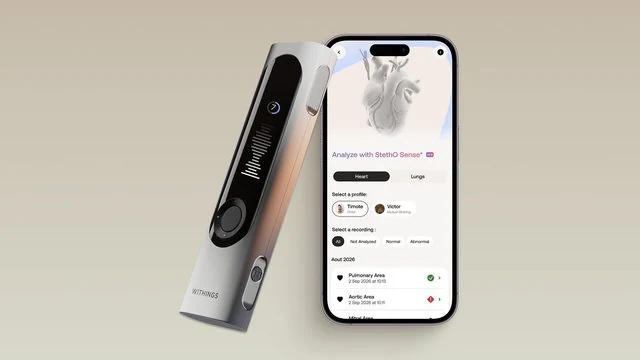
Home recordings become a starting point for a health conversation
Withings makes connected health devices.
AI interpretation enters home health routines, with clinician follow-up and regional eligibility rather than autonomous care.
Why this example is here
Requires BeamO, Withings+ and supported software in eligible EU/EEA territories. Results are not a diagnosis or an emergency service, and a reassuring result cannot rule out illness.
Original sourceEditorial selection · reviewed 1 Nov 2026
Menopause support arrives with something to take to the appointment
Empress Health is a menopause-support platform.
A life-stage-specific service combines ongoing questions and symptom records with preparation for a clinician visit.
Why this example is here
Education and preparation, not diagnosis, prescribing or replacement medical care. Some tools require membership; the platform also recommends products from a related brand.
Original sourceEditorial selection · reviewed 1 Nov 2026
Dates distinguish launches, announcements and substantial updates. Examples with a more indirect connection are labelled.
Explore the sub-shifts
These more specific changes show how the main shift could play out in everyday life.

“CONTINUOUS CARE”
Support should survive the journey between one appointment and the next.

“PERSONAL PREVENTION”
As health signals arrive earlier, consumers will expect somewhere useful to take them.

“LONGEVITY MARKETS”
A future body becomes something to purchase—and a new way to describe yourself.

“ANTI-OPTIMIZATION”
A growing health service should not require a growing job from its customers.
THE SOURCE NOTESFollow the thinking 5 sources · what they show and where their limits lie
Sources and further reading
These sources inform the article. A product announcement describes an offer, not how widely people use it. Arguments and imagined futures are kept separate from observed results.
Expert argument about evidence and implementation; not itself a clinical trial.
Normative framework; not evidence that a particular AI product improves health.
Full substantive essay read; only research-agenda argument used, not underlying statistics or clinical-efficacy claims. Commercial affiliation explicit.
This study used medical scenarios rather than measuring clinical outcomes. We could not access the publisher’s full paper.
About this research edition
This article draws on selected sources and our interpretation of their implications for consumers. The wider collection contains 50 articles and original illustrations. We have not read everything by everyone on the reading list, calculated the probability of each future or established worldwide adoption. The collection is not exhaustive.
The illustrations are AI-generated, with a visual approach informed by TrendWatching’s 2024 and 2025 reports. They depict ideas rather than observed events. If an article’s central idea changes, its image needs another look. Small edits need not mean a new illustration; automatic replacement is not active.
Each innovation has a source, a review date and an explanation of its relevance and limits. Some are early signs of the change; others offer a useful comparison. None proves the forecast. Monthly monitoring and automatic selection of new examples are not running.