

Sub-shift
“NOT ALL OF ME”
People may want continuity in one part of life without carrying it into every other.

A person can be candid with a friend, tentative in a classroom and practical at work. They can explore an idea without announcing that it defines them. Keeping these settings separate is an ordinary part of living with other people.
Connected AI services introduce a different possibility: information from one setting can inform an encounter elsewhere. That continuity may save effort and make help more useful. It can also carry an interpretation further than the person expected.
Over the next one to three years, some consumers may deliberately separate services or spaces for private reflection, learning and everyday tasks. Others will choose a connected experience because repeating themselves is too much work.
A detail has a setting
Helen Nissenbaum's account of contextual integrity explains privacy through appropriate information flows, rather than secrecy alone. Who receives information, for what purpose and in which setting affects whether sharing feels appropriate. Applying that thinking to AI, a personal disclosure need not become an all-purpose description of its author. [67]
A learning tool might usefully remember where someone struggles. That does not mean the person wants the difficulty to become part of how other services describe them. Exploring a different way of living is not the same as asking every shopping experience to reflect it.
The consumer interest is therefore more specific than having either a comprehensive profile or no memory at all. Some people may want a service to know them well for a particular purpose while leaving other parts of life alone. This could become a reason to choose a smaller, more bounded service over one that promises to connect everything.
Make the separation part of the offer
If your service invites personal reflection, tell customers what will remain within that setting and what may travel beyond it. Where the architecture supports it, make those boundaries easy to maintain in ordinary use. Someone should not need to become an expert in account settings just to try out an idea privately.
Be equally clear about limitations. Removing a name does not guarantee that information cannot be linked. A switch labelled private cannot establish a boundary the underlying system does not maintain. The promise has to match what actually happens.
There will be costs to separation: less convenient continuity, repeated explanations, perhaps harder recovery. Some customers will decide the integrated option is worth it. Others may accept those inconveniences to keep an exploratory part of themselves from becoming the version every service remembers.
For businesses, this is an opportunity to offer a useful relationship with a defined scope. Customers may value a service that remembers what helps with a particular job and lets that history go when it is no longer useful. They may want to return to you without bringing their entire life along.
Early signs of change.
by TrendWatching
2 closely related examples from the Innovation Database. Each helps explain an aspect of the shift. None establishes that the whole forecast will happen.

Likeness services add identity verification and takedown requests
Twinnin offers services for verifying identity and managing AI uses of human likeness.
Identity and objection records give people a way to contest AI uses of their likeness; successful prevention is not guaranteed.
Why this example is here
Identity verification, objection record and takedown requests; not guaranteed prevention/removal/enforcement. Partner network potential reach is not actual active users.
Original sourceEditorial selection · reviewed 1 Nov 2026
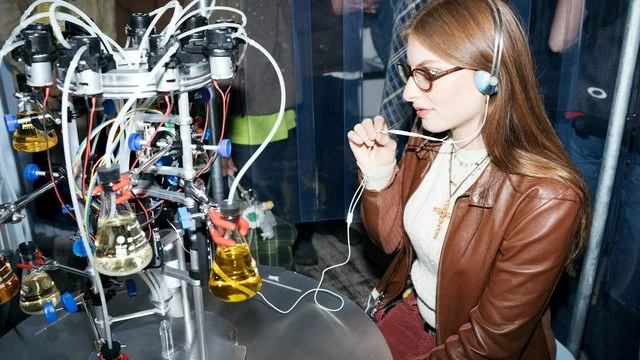
Experience image
A spoken memory becomes a personal fragrance
London fragrance house Index
The operator offers private archives and optional public sharing of selected details; privacy is a stated design policy, not independently audited.
Why this example is here
This interprets a story rather than reproducing a memory or demonstrating lasting identity change. The September pop-up has ended; a separate October event was also temporary.
Original sourceEditorial selection · reviewed 1 Nov 2026
Dates distinguish launches, announcements and substantial updates. Examples with a more indirect connection are labelled.
See the full selection for “SELF, REWRITTEN”THE SOURCE NOTESFollow the thinking 1 source · what they show and where their limits lie
Sources and further reading
These sources inform the article. A product announcement describes an offer, not how widely people use it. Arguments and imagined futures are kept separate from observed results.
The argument concerns appropriate information flows, rather than secrecy alone. The identity boundaries proposed in our article are an application of that thinking, not a guarantee of technical capability.
About this research edition
This article draws on selected sources and our interpretation of their implications for consumers. The wider collection contains 50 articles and original illustrations. We have not read everything by everyone on the reading list, calculated the probability of each future or established worldwide adoption. The collection is not exhaustive.
The illustrations are AI-generated, with a visual approach informed by TrendWatching’s 2024 and 2025 reports. They depict ideas rather than observed events. If an article’s central idea changes, its image needs another look. Small edits need not mean a new illustration; automatic replacement is not active.
Each innovation has a source, a review date and an explanation of its relevance and limits. Some are early signs of the change; others offer a useful comparison. None proves the forecast. Monthly monitoring and automatic selection of new examples are not running.