

As more capabilities become affordable, who can benefit still depends on the circumstances of a life.

A person can be delighted by what AI saves them and worried about what it means for their earnings. They can gain affordable help with a difficult task while still being unable to afford the time, equipment or professional support needed to act on it. Both experiences belong in a consumer strategy.
“UNEQUAL TOMORROWS” follows the different ways households could turn greater capability into a better life. Some will buy an expanding collection of personal assistance. Others may receive useful tools through schools, employers or public services. For people facing uncertain income, the most attractive offer could be one they can pause, adapt or leave without losing what they have built.
Over the next one to three years, expect those circumstances to influence which promises people find credible. A low entry price is appealing. So is having someone to help when the tool becomes confusing, an important decision needs checking or the household budget changes.
The opportunity for you reaches beyond an affordable version of a premium product. It includes different ways to pay, obtain support and remain able to participate.
What drives this
Access to information has already widened without making everyone equally able to use it. The World Bank’s 2025 AI-foundations report describes connectivity, computing resources, relevant data and skills as interdependent conditions. It also identifies opportunities for smaller, locally adapted applications. The report concerns economies; applying those conditions to a household is our interpretation. [81]
AI adds another layer to the choices people make. They can attempt more with inexpensive assistance, but the support around a task may still be scarce. Someone with a stable connection, confidence in the subject and a professional to consult can take a different risk from a person who cannot afford a mistake.
The distribution of gains is not settled by the technology. In a customer-support workplace studied by Erik Brynjolfsson, Danielle Li and Lindsey Raymond, less-experienced and lower-skilled workers gained more from AI assistance. That bounded finding challenges a simple story in which greater capability always favors existing experts. It does not establish an equalizing effect on household incomes. [82]
There are choices over the wealth created, too. Scott Santens’s 2026 argument for a basic-income dividend is one proposed way to share collectively produced prosperity. It is not an automatic result of automation. Public services, shared provision and ownership arrangements offer other possible routes. Those decisions could change how much of a good life people have to purchase individually. [104]
A changing reason to commit
Consider a household whose work becomes less predictable. It may value a shorter commitment even before income falls. Another household may gain enough from cheaper services or better-paid work to experiment more. These are consumer responses to investigate, not conclusions to draw from a headline about jobs exposed to AI.
If you build for only one path, your offer may become difficult to keep precisely when a customer needs continuity. Records, useful work and access to support should not disappear without warning when a person changes employment or cannot renew a plan. Explain the choices available and the consequences of each.
The surrounding economy also matters. Cheaper digital production does not make homes, care or skilled physical work plentiful on the same timetable. A saving in one part of the budget may be absorbed elsewhere. You will need to understand which constraint actually stops the customer from doing what your product makes imaginable.
Capability can arrive through a relationship
An individual subscription is one route. A school, local institution or member organization can secure access and provide support on different terms. That could help people who would not confidently choose and manage the tool alone. It can also create dependencies on funding, institutional rules and a particular supplier.
Elinor Ostrom’s 2010 account of varied governance arrangements provides a useful starting point for thinking beyond a simple market-or-state choice. It does not validate any particular AI service. It directs attention to who sets the terms, benefits and can challenge a decision. [83]
For businesses, serving these groups could become a substantial opportunity. The proposition includes the help around the technology, continuity when circumstances change and terms people can understand. Measure what customers can actually accomplish, including those who arrive with less confidence or support. That is where a broad promise of access becomes a product worth keeping.
Early signs of change.
by TrendWatching
3 selected innovations from the Innovation Database. Each helps explain an aspect of the shift. None establishes that the whole forecast will happen.

Campaign or promotional image
Dubai gives families a free guide to using AI together
GenDubAI is a family AI-literacy initiative from Dubai's public institutions.
Public institutions provide family AI-literacy support without requiring each person to buy a private subscription.
Why this example is here
An Arabic- and English-language pilot for families with children aged 8–15. It offers guidance, not premium AI subscriptions or proven reductions in inequality.
Original sourceEditorial selection · reviewed 1 Nov 2026
Translation models work without a cloud connection
Tether AI Research develops open-source AI models.
Offline local-language models address practical barriers to accessing AI capabilities, rather than promising that availability alone equalizes outcomes.
Why this example is here
A model release, not a universal consumer app. Device compatibility, implementation and translation quality still matter. Benchmark comparisons are the developer's claims.
Original sourceEditorial selection · reviewed 1 Nov 2026
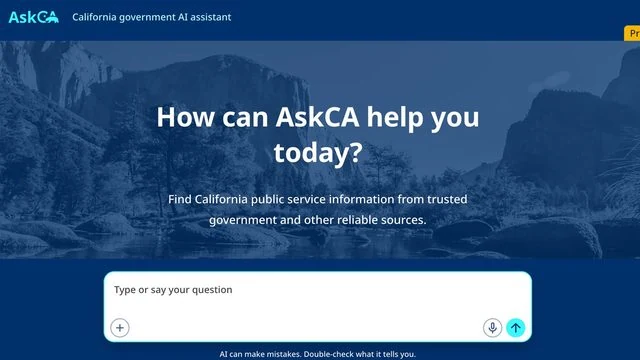
Product interface
Ask for help without first learning how government is organized
AskCA is a California government AI-assistant prototype.
Government provides AI navigation toward public support through a pilot, rather than relying on an individual premium subscription.
Why this example is here
A prototype that can make mistakes, not a benefit decision or guarantee of eligibility. Pilot recruitment was for California residents aged 18 and over; improved access outcomes have not been established.
Original sourceEditorial selection · reviewed 1 Nov 2026
Dates distinguish launches, announcements and substantial updates. Examples with a more indirect connection are labelled.
Explore the sub-shifts
These more specific changes show how the main shift could play out in everyday life.

“PREMIUM INTELLIGENCE STACKS”
The advantage may come from everything a customer can assemble around the model.

“INCOME RESILIENCE”
A useful offer needs to survive a change in the customer’s working life.

“ACCESS OVER OWNERSHIP”
Useful capability could become part of membership, education or public life.

“CONSTRAINED ABUNDANCE”
Consumers will want help turning abundant possibilities into things they can actually have.
THE SOURCE NOTESFollow the thinking 4 sources · what they show and where their limits lie
Sources and further reading
These sources inform the article. A product announcement describes an offer, not how widely people use it. Arguments and imagined futures are kept separate from observed results.
We read the overview and foreword, rather than every chapter. The report examines the foundations for AI and uneven adoption across economies; the household implications are our interpretation.
We read the abstract and the introduction and results summary. The research concerns one customer-support setting. Larger gains for novices do not establish effects on wages or inequality across the economy.
Author proposal, not enacted policy or inevitable automation outcome. Alternatives explicitly editorial possibilities. Actual source read in prior research pass.
Governance lens, not research validating contemporary AI commons.
About this research edition
This article draws on selected sources and our interpretation of their implications for consumers. The wider collection contains 50 articles and original illustrations. We have not read everything by everyone on the reading list, calculated the probability of each future or established worldwide adoption. The collection is not exhaustive.
The illustrations are AI-generated, with a visual approach informed by TrendWatching’s 2024 and 2025 reports. They depict ideas rather than observed events. If an article’s central idea changes, its image needs another look. Small edits need not mean a new illustration; automatic replacement is not active.
Each innovation has a source, a review date and an explanation of its relevance and limits. Some are early signs of the change; others offer a useful comparison. None proves the forecast. Monthly monitoring and automatic selection of new examples are not running.