

Sub-shift
“HYBRID COMMUNITIES”
Groups gain artificial participants. Members will decide what they are there for.

A hobby group is trying to organize its next meeting. Half the members missed the discussion, a newcomer does not know the shared references, and the person who usually sorts everything out is busy. An artificial participant could make itself useful here without pretending to be another friend.
That is one direction we expect mixed human-and-AI social spaces to take over the next one to three years. People may invite an assistant into a group for a particular job, or make an artificial character part of a shared game. What they want from it will differ from what they expect of the people alongside it.
The opportunity is to help a group do something it values together. A rising message count will not, on its own, tell you whether members value the experience.
A shared role changes the experience
Most personalization starts with one person: their preferences, their history, their next request. A group brings different loyalties and competing wishes. The most pleasing answer for one member may irritate another. Remembering a private concern is different from repeating it in front of everyone.
This makes shared AI a social proposition as much as a technical one. A group might welcome a patient guide to the rules of a game but dislike a character that interrupts every conversation. It may want help remembering a decision while reserving the decision itself for members. Acceptance could depend on a modest, understandable role rather than the most human-like performance.
There are research precedents for assistance with group life. Tessler and colleagues' 2024 Habermas Machine experiments found that AI-mediated statements could help people find common ground in structured UK deliberations. The finding does not establish that adding synthetic members produces healthy communities; it concerns help with a particular group process. [52]
Something the members would miss
For a community host, look at the work that repeatedly falls to the same few people. Explaining how things work, recapping what was agreed, preparing the next activity. Where members want assistance, reducing that burden might make a group easier to sustain. It could also give newcomers a way in without expecting an established member to be permanently available.
Other groups will want a more imaginative role: a fictional character shared by everyone, for example, whose presence becomes part of the activity. Treat that as a choice to make with members. The identity of the operator, access to private exchanges and any commercial purpose should be clear enough to understand during ordinary use.
The business case needs to rest on the human group's experience. Are people returning, contributing and finding one another? Would they miss what the artificial participant helps them do? Extra message volume can answer none of those questions. You may find that the most useful shared assistant speaks only occasionally, leaving the group with more time and energy for itself.
Early signs of change.
by TrendWatching
1 closely related example from the Innovation Database. Each helps explain an aspect of the shift. None establishes that the whole forecast will happen.
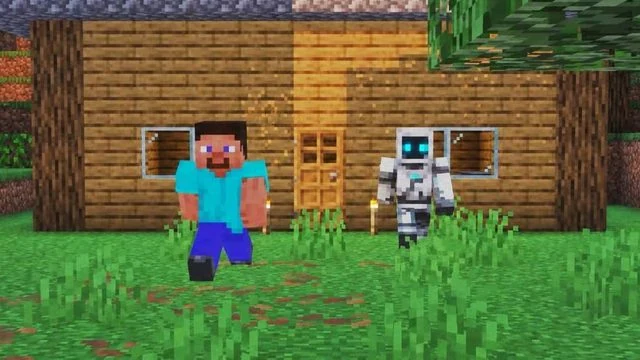
Minecraft add-on adds simulated players to solo worlds
Gamemode One develops Minecraft content and add-ons.
Traditional game AI simulates other participants; this is not a generative companion or evidence of human friendship.
Why this example is here
Traditional in-game AI, NOT generative AI; offline after download, Bedrock; can mix artificial and human participants. FAQ https://support.gamemodeone.com/hc/en-us/articles/55874656159003-Frequently-Asked-Questions-for-AI-Players-Add-On (October16 update is not launch). No social wellbeing claim.
Original sourceEditorial selection · reviewed 1 Nov 2026
Dates distinguish launches, announcements and substantial updates. Examples with a more indirect connection are labelled.
See the full selection for “MORE THAN HUMAN COMPANY”THE SOURCE NOTESFollow the thinking 1 source · what they show and where their limits lie
Sources and further reading
These sources inform the article. A product announcement describes an offer, not how widely people use it. Arguments and imagined futures are kept separate from observed results.
UK group-statement experiments, not proof of durable communities or universal consensus benefits.
About this research edition
This article draws on selected sources and our interpretation of their implications for consumers. The wider collection contains 50 articles and original illustrations. We have not read everything by everyone on the reading list, calculated the probability of each future or established worldwide adoption. The collection is not exhaustive.
The illustrations are AI-generated, with a visual approach informed by TrendWatching’s 2024 and 2025 reports. They depict ideas rather than observed events. If an article’s central idea changes, its image needs another look. Small edits need not mean a new illustration; automatic replacement is not active.
Each innovation has a source, a review date and an explanation of its relevance and limits. Some are early signs of the change; others offer a useful comparison. None proves the forecast. Monthly monitoring and automatic selection of new examples are not running.