

Sub-shift
“HOUSEHOLD AUTOPILOT”
Households will look for help that takes responsibility for the follow-through.

A school asks for a form. Someone reads the message, finds the information, checks the deadline and remembers to send it. The task may take ten minutes. Responsibility for it can occupy several days.
This is the work that “HOUSEHOLD AUTOPILOT” needs to address. Shared calendars and reminders can make a household more organized without changing who keeps everything together. The next expectation is for assistance that notices what needs doing, carries an agreed task through and leaves fewer obligations waiting for someone to remember them.
The work around the chore
Sociologist Allison Daminger’s 2019 account of interviews with 35 couples separates anticipating needs and monitoring outcomes from making decisions. Women in that particular, predominantly middle- and upper-middle-class sample carried more anticipation and monitoring, even where decisions were shared. The findings are not a picture of every home. They do show why equal participation in a visible task can coexist with unequal responsibility for it. [12]
Our one-to-three-year forecast is that household services will increasingly be judged on whether they relieve that responsibility. Putting an appointment in the calendar is useful. Checking that transport is arranged and asking the right person when it is not could be more valuable still. These are prospective service functions, not claims about a proven autonomous household product.
Connecting messages, calendars and bookings makes more of this work available to software. It also exposes the complications that a family member used to resolve quietly: an outdated instruction, an unspoken preference, a relative who does not use the same app. The service has to make room for those circumstances if people are going to rely on it.
Help should reach the people carrying the load
Imagine a shared service dealing with transport to an appointment. One person has accepted responsibility for the journey. If the original plan fails, the service asks that person to choose an alternative, rather than automatically returning the problem to whoever first set up the account. The distinction is small in interface terms and substantial in household life.
A product that sends every uncertain decision to the usual organizer may make that person busier. They now oversee the household and troubleshoot its software. Measuring notifications sent or tasks generated would tell a cheerful story while missing the result that matters.
For businesses building family services, start with a recurring obligation and follow it through the week. Find out who notices it, who decides, who acts and who checks. Then consider which parts your service can take on with permission and which should remain with a person. You may find that the greatest value lies in completing a dull handover rather than adding another feature to the shared calendar.
Households also contain private lives. Sharing a home does not make every appointment, purchase or message common property. People need to choose what a joint service can see and act on without surrendering the usefulness of the whole arrangement.
A family may happily keep choosing its activities while paying someone to handle the arrangements that follow. That creates room for services sold around a continuing responsibility: keeping appointments coordinated, for example, rather than supplying another calendar. The value will be felt by the person who can finally stop checking whether everything has been sorted. If they still have to check, the service has more work to do.
Early signs of change.
by TrendWatching
2 closely related examples from the Innovation Database. Each helps explain an aspect of the shift. None establishes that the whole forecast will happen.
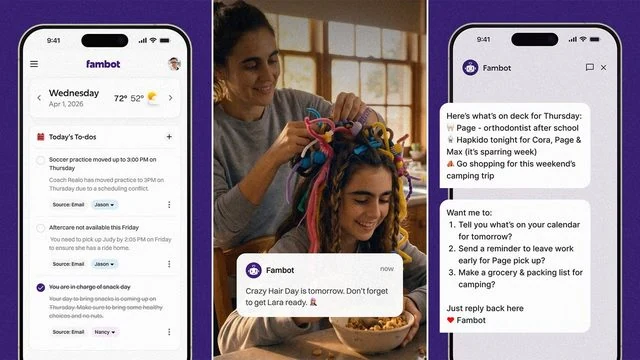
Family assistant turns messages into shared plans
Fambot is an AI assistant for coordinating family schedules and communications.
Shared plans and reminders support household follow-through; completed autonomous tasks are not established.
Why this example is here
The service provides a digest, shared tasks and communications. Household autonomy, equal workloads and independently verified adoption have not been established.
Original sourceEditorial selection · reviewed 1 Nov 2026

Product image
Ask for the atmosphere. Let the lights work out the settings.
Nanoleaf makes connected lighting.
A small piece of household setup can be carried out from an intended outcome; it does not assume responsibility for the whole household.
Why this example is here
Requires compatible devices, account authorization and a running desktop app. This is bounded lighting control, not an autonomous household manager.
Original sourceEditorial selection · reviewed 1 Nov 2026
Dates distinguish launches, announcements and substantial updates. Examples with a more indirect connection are labelled.
See the full selection for “LIFE ON DELEGATE”THE SOURCE NOTESFollow the thinking 1 source · what they show and where their limits lie
Sources and further reading
These sources inform the article. A product announcement describes an offer, not how widely people use it. Arguments and imagined futures are kept separate from observed results.
We read the author’s full account of interviews with 35 couples. The sample limits how widely the findings can be applied. The study did not test AI or its effects on household work.
About this research edition
This article draws on selected sources and our interpretation of their implications for consumers. The wider collection contains 50 articles and original illustrations. We have not read everything by everyone on the reading list, calculated the probability of each future or established worldwide adoption. The collection is not exhaustive.
The illustrations are AI-generated, with a visual approach informed by TrendWatching’s 2024 and 2025 reports. They depict ideas rather than observed events. If an article’s central idea changes, its image needs another look. Small edits need not mean a new illustration; automatic replacement is not active.
Each innovation has a source, a review date and an explanation of its relevance and limits. Some are early signs of the change; others offer a useful comparison. None proves the forecast. Monthly monitoring and automatic selection of new examples are not running.