

Consumers will expect more of the work of everyday life to be finished on their behalf.

A purchase can take seconds and leave weeks of work behind it. Find out why the delivery never arrived. Arrange the repair. Remember to call again. Consumer services have become very good at letting people start things. Finishing them can still depend on the customer.
That experience gives AI delegation a much bigger opportunity than a quicker way to search. People want to be able to hand something over and carry on with their day, knowing that somebody—or something—will follow it through. They already pay people to do this when they can afford to. Software could make parts of that service available for more ordinary tasks, at prices that make sense for more households.
Over the next one to three years, we expect consumers to become more selective about the work they keep for themselves. They may enjoy choosing a holiday and happily give away the job of rearranging its transfers. They may care deeply about a purchase and have no interest in spending an afternoon chasing its warranty. “LIFE ON DELEGATE” describes the expectation that a service can take on that continuing work within boundaries the customer has agreed.
From helping with a step to carrying a task
Self-service put useful powers in consumers’ hands. People could compare offers, make bookings and change their plans without waiting for an office to open. It also made them responsible for navigating the process. Even a helpful reminder leaves someone with a job to do.
The next development is a service that can work through several steps: understand the request, contact the relevant provider, make an authorized change and establish whether it happened. When that works reliably, the customer has less reason to visit every screen along the way. Their attention becomes necessary when something important changes, rather than whenever another form needs completing.
Google’s 13 October 2026 Gemini update offers a current sign of that direction. Pro and Ultra subscribers gained an updated task experience in the chat window, with work able to continue while they are away from the computer and connections to services including grocery ordering and restaurant booking. This is an announced product capability, not evidence that open-ended household administration can now be left unattended. [108]
The consumer expectation we foresee goes further: if a service accepts a task, it should keep track of the unresolved parts. A reservation request and a confirmed table are different outcomes. A customer should know which one they have without having to investigate.
What drives this
The burden of a task often begins before anyone performs it and continues afterwards. Sociologist Allison Daminger’s 2019 research distinguished anticipating a household need, considering options, deciding and monitoring. Her interviews showed why a list of completed chores can miss the responsibility people carry between them. Applied to AI, that distinction helps explain why automating visible actions may leave much of the load untouched. [12]
Delegation becomes valuable when people can stop keeping the unfinished task in mind. That could change what they consider worth paying for. A service that deals with a failed delivery may be more useful than another source of product recommendations. A maintenance plan may earn its price by arranging the visit, checking the repair and dealing with a second failure.
There are limits to how completely anyone can hand over a decision. A repair might exceed the agreed budget; an appointment might require taking time off work. Economist Oliver Hart’s work on incomplete contracts concerns who has authority when an agreement has not anticipated a situation. Applied to consumer services, the question is practical: who gets to change the plan? The theory is older than these tools; this application is ours. [13]
Your customer may stop doing your coordination
For businesses, this creates an opportunity to take responsibility for a larger part of the experience. If you sell an appliance, consider the work a customer must do to keep it useful. If you arrange travel, consider what they have to reconstruct when one part changes. There may be a valuable service in the gaps between the things you already sell.
A capable delegate could also change which business the customer deals with. Someone might ask a service they already trust to find a repairer, arrange the visit and follow up, rather than start with the manufacturer's website. In that scenario, the company doing the repair wins work partly by being easy for the delegate to work with. Businesses may have to earn a place in someone else's service, while competing to become the service consumers choose to put in charge.
The shift will remain uneven. Complex needs, inaccessible services and conflicting household priorities can leave people supervising more than they save. Some consumers will prefer direct involvement. Those limits make it important to start with tasks a provider can genuinely finish, including when something goes wrong. Offer that relief consistently and customers have a reason to give you more responsibility.
Early signs of change.
by TrendWatching
3 selected innovations from the Innovation Database. Each helps explain an aspect of the shift. None establishes that the whole forecast will happen.
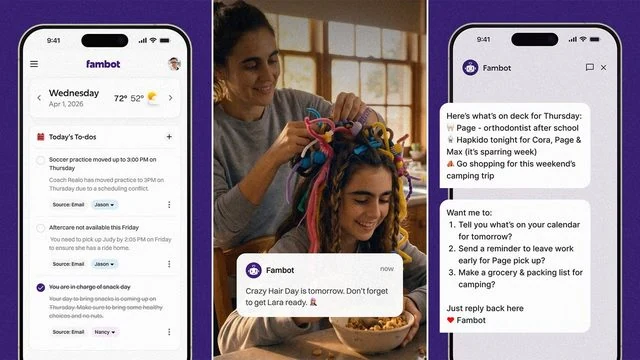
Family assistant turns messages into shared plans
Fambot is an AI assistant for coordinating family schedules and communications.
Shared plans and reminders support household follow-through; completed autonomous tasks are not established.
Why this example is here
The service provides a digest, shared tasks and communications. Household autonomy, equal workloads and independently verified adoption have not been established.
Original sourceEditorial selection · reviewed 1 Nov 2026

Product image
Ask for the atmosphere. Let the lights work out the settings.
Nanoleaf makes connected lighting.
Its new MCP connection lets a compatible AI assistant change supported lights and create scenes from a description or image. The customer can specify an atmosphere rather than configure every color and transition.
Why this example is here
Requires compatible devices, account authorization and a running desktop app. This is bounded lighting control, not an autonomous household manager.
Original sourceEditorial selection · reviewed 1 Nov 2026
A hotel conversation reaches the booking and payment
Travala is a crypto-native travel booking platform.
Travala’s browser-based agent searches its hotel inventory, presents options and completes a booking after the traveler authorizes payment from a supported wallet. The useful change is carrying the conversation through to a transaction.
Why this example is here
Hotels only at launch; flights and other travel products were planned. Requires a funded BNB Smart Chain wallet and payment approval. This is not unrestricted spending authority.
Original sourceEditorial selection · reviewed 1 Nov 2026
Dates distinguish launches, announcements and substantial updates. Examples with a more indirect connection are labelled.
Explore the sub-shifts
These more specific changes show how the main shift could play out in everyday life.

“SILENT SHOPPING”
Some purchases will compete for a place in the standing order, rather than another moment of attention.

“HOUSEHOLD AUTOPILOT”
Households will look for help that takes responsibility for the follow-through.

“OUTCOME SUBSCRIPTIONS”
Consumers may pay a provider to keep a useful part of life working, with fewer problems left for them to manage.

“COLLECTIVE AGENTS”
Shared needs could become easier to organize into a shared purchasing decision.
THE SOURCE NOTESFollow the thinking 3 sources · what they show and where their limits lie
Sources and further reading
These sources inform the article. A product announcement describes an offer, not how widely people use it. Arguments and imagined futures are kept separate from observed results.
Full authored body read. Task toggle/background work and connected-app tasks announced for Pro/Ultra; no claim first-ever background agent, unrestricted authority, independent reliability or household impact.
We read the author’s full account of interviews with 35 couples. The sample limits how widely the findings can be applied. The study did not test AI or its effects on household work.
The argument concerns who holds decision-making authority when an economic agreement leaves matters unspecified. Its application to consumer delegates and outcome services is our interpretation.
About this research edition
This article draws on selected sources and our interpretation of their implications for consumers. The wider collection contains 50 articles and original illustrations. We have not read everything by everyone on the reading list, calculated the probability of each future or established worldwide adoption. The collection is not exhaustive.
The illustrations are AI-generated, with a visual approach informed by TrendWatching’s 2024 and 2025 reports. They depict ideas rather than observed events. If an article’s central idea changes, its image needs another look. Small edits need not mean a new illustration; automatic replacement is not active.
Each innovation has a source, a review date and an explanation of its relevance and limits. Some are early signs of the change; others offer a useful comparison. None proves the forecast. Monthly monitoring and automatic selection of new examples are not running.